
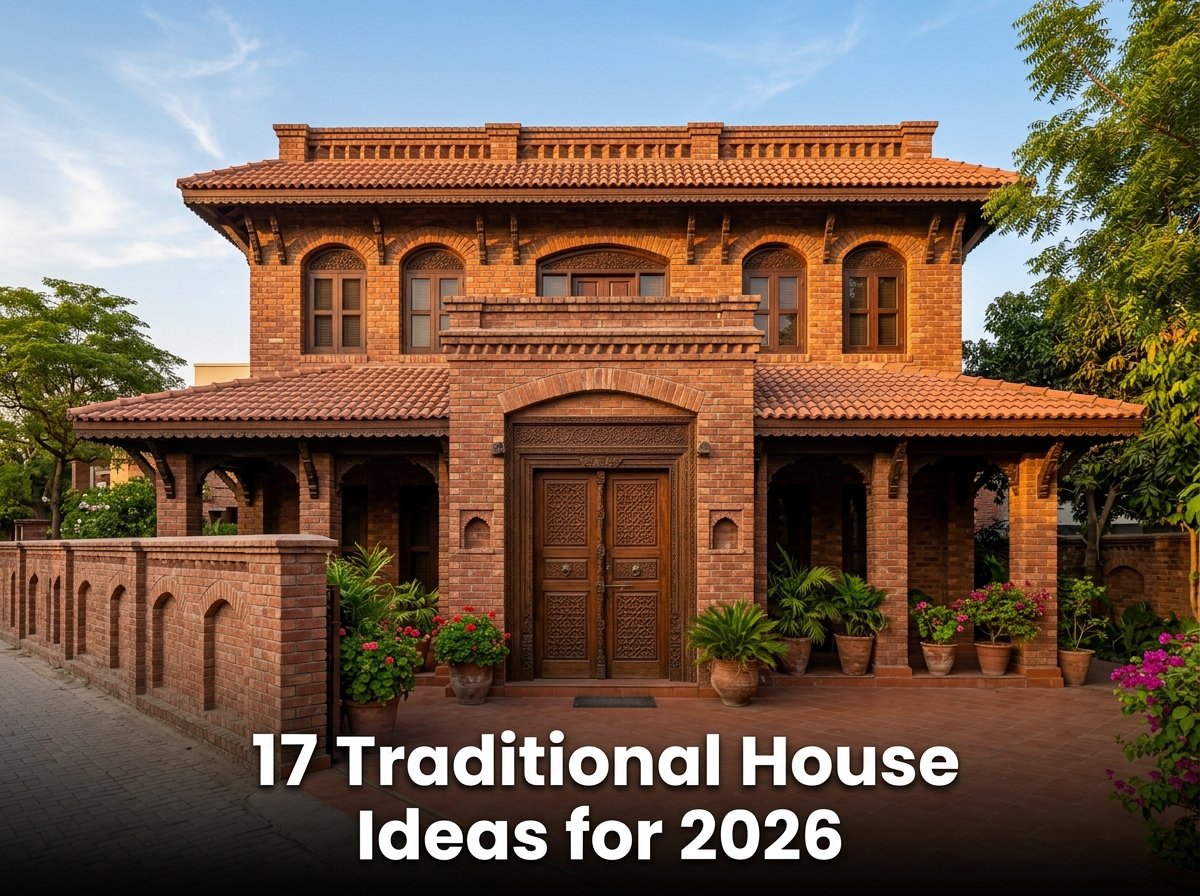
17 Traditional House Ideas for 2026
I visited my grandmother’s house in rural Punjab last year and stood in the central courtyard for twenty minutes just looking at the carved wooden doors, the brick archways, and the hand-plastered walls with their subtle texture. The house was built in 1962 and every room felt deliberate and permanent in a way that most new construction simply does not. That visit made me want to document what makes traditional houses worth studying and replicating in 2026.
If you want traditional house ideas, all 17 options here cover exterior design, interior layout, construction materials, and decorative approaches drawn from Pakistani, South Asian, and globally recognized traditional residential styles. Every idea applies to new construction and renovation projects at a range of budget levels.
These ideas cover courtyard houses, brick bungalows, wooden haveli-style interiors, mud plaster finishes, and carved stone facades. I selected each one because the design element produces a strong cultural identity, improves the functional quality of the living space, or reduces long-term construction costs compared to contemporary alternatives.
Each section states the specific design feature, the materials required, and the approximate application in a residential setting so homeowners, builders, and interior designers find clear, usable information in every section.
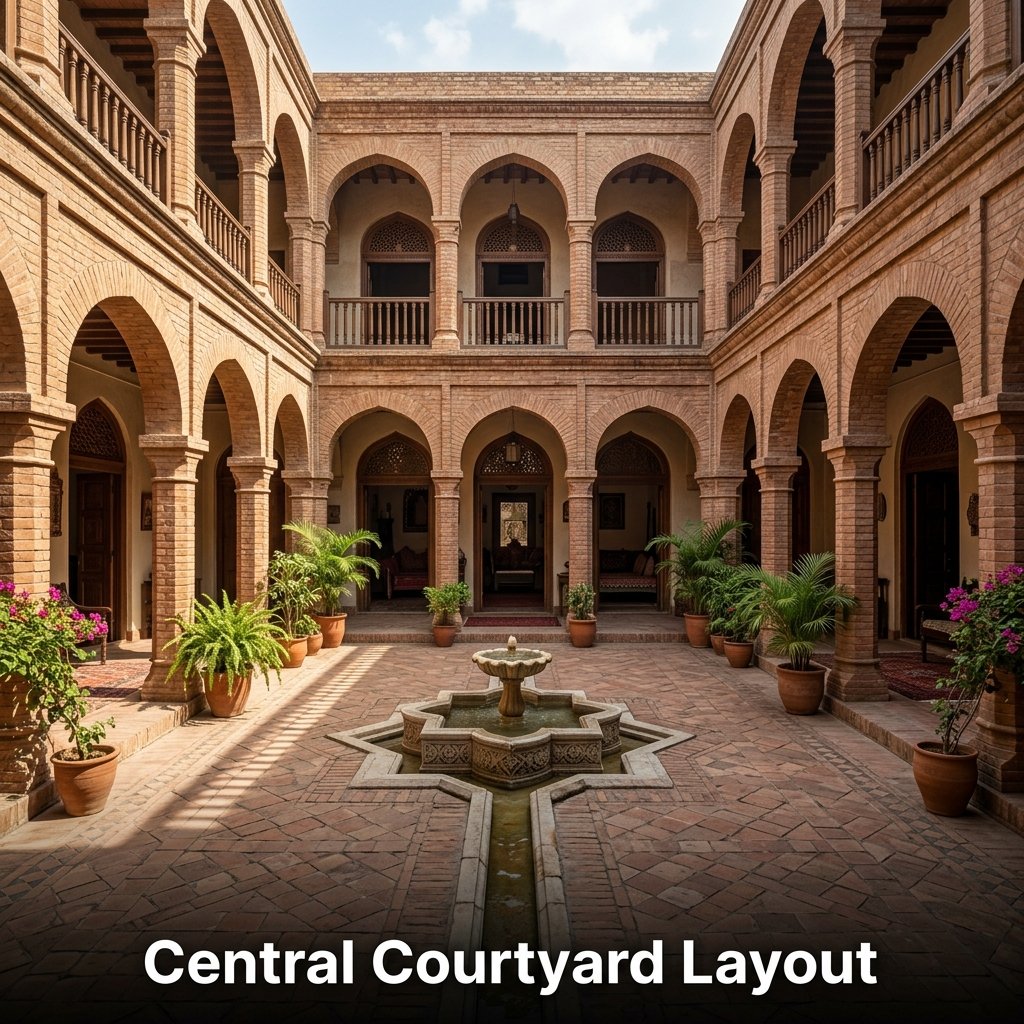
1. Central Courtyard Layout
A central courtyard layout places an open-air interior courtyard at the geometric center of the house floor plan, with all main rooms opening directly onto the courtyard rather than onto external streets or a central corridor. I saw this layout used in a traditional house design in Pakistan in Lahore’s old city quarter where houses built around central courtyards maintained interior temperatures 4 to 6 degrees Celsius cooler than street-facing rooms during summer months. The courtyard acts as a natural ventilation shaft that draws hot air upward and out of the house.
Traditional courtyard houses remain one of the most consistently effective passive cooling solutions in hot climates, which is why the layout continues to feature in modern traditional house ideas for South Asian residential architecture.
Courtyard Dimensions for a Residential House
A functional residential courtyard measures a minimum of 4 x 4 meters for a house with a 150-square-meter floor area. Larger houses at 250 square meters or above benefit from courtyards at 6 x 8 meters or more. The courtyard width determines the depth of natural light that reaches the surrounding rooms. A courtyard narrower than 3 meters produces insufficient light penetration into rooms deeper than 5 meters from the courtyard opening, particularly in rooms on the ground floor beneath upper-story overhangs.
Traditional Courtyard Features in Pakistani House Design
Traditional courtyard houses in Pakistan incorporate 3 specific features: a central water feature such as a small fountain or planted channel, a covered verandah running along at least 2 sides of the courtyard, and carved wooden screens called jaali fixed above doorways for ventilation without direct sun exposure. The water feature reduces the courtyard air temperature through evaporative cooling. The verandah provides shaded outdoor living space between the courtyard and the interior rooms throughout the day.
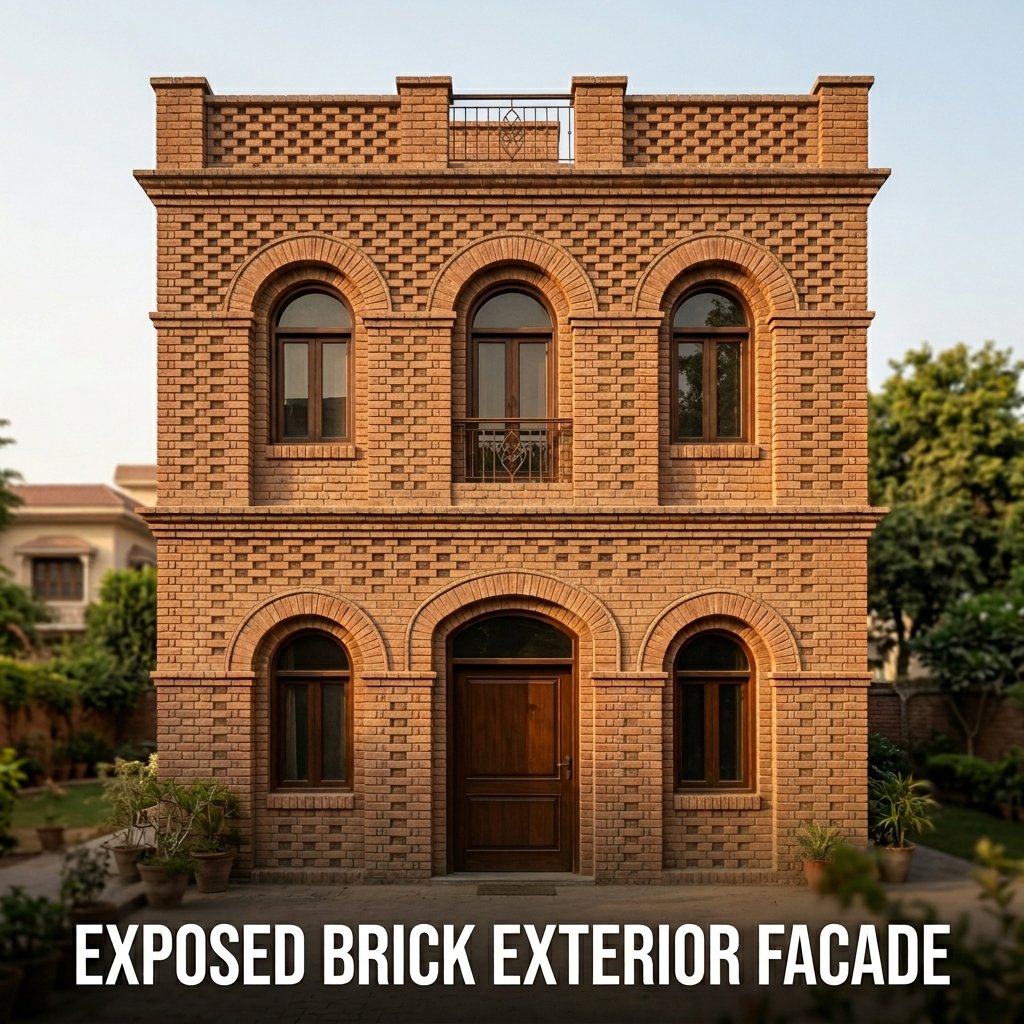
2. Exposed Brick Exterior Facade
An exposed brick exterior facade uses kiln-fired clay bricks laid in a traditional bond pattern and left unrendered to produce the finished external wall surface of a house. I noticed that traditional houses in Punjab, Sindh, and across northern India with exposed brick exteriors required significantly less exterior maintenance than rendered cement-plastered houses in the same neighborhoods over comparable time periods. Brick naturally weathers without deteriorating and requires no repainting cycle.
Exposed brick exteriors are among the most searched simple traditional house ideas because the material communicates permanence and cultural continuity in both rural village house contexts and urban residential settings.
Brick Types for Traditional House Exteriors
Three brick types suit traditional house exterior facades: hand-molded clay bricks at 230 x 110 x 75 mm for a traditional South Asian appearance, wire-cut engineering bricks for a more uniform modern-traditional result, and reclaimed bricks sourced from demolished older structures for a heritage appearance. Hand-molded clay bricks vary slightly in size and surface texture, which produces the characteristic irregular appearance of traditional brick construction that machine-manufactured bricks do not replicate.
Traditional Brick Bond Patterns for Facades
Flemish bond lays alternating headers and stretchers in every course and produces a more decorative facade pattern than running bond. English bond alternates full stretcher courses with full header courses and produces the strongest brick wall structure. Rat trap bond stands bricks on edge rather than flat, which reduces the number of bricks required per square meter of wall by 25% while producing a visually distinctive traditional appearance suited to low-cost traditional house design ideas in rural areas.
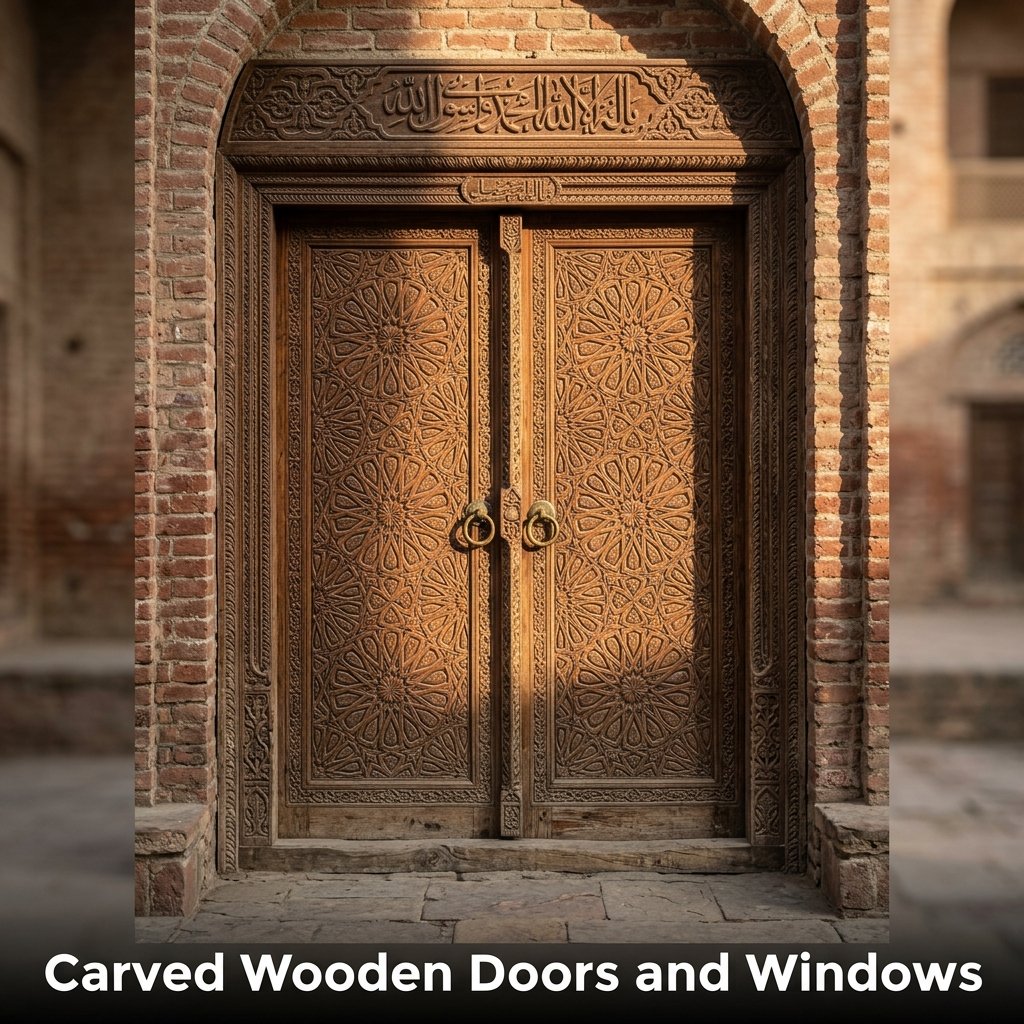
3. Carved Wooden Doors and Windows
Carved wooden doors and windows use geometric, floral, or calligraphic patterns cut into solid timber door and window frames as the primary decorative element on the exterior facade of a traditional house. I photographed carved wooden doors in Lahore’s Walled City, in Multan’s old residential quarters, and in Peshawar’s Qissa Khwani Bazaar area and found that the carved timber elements consistently defined the visual character of each building more than any other single architectural feature. A plain brick house with a carved wooden door reads as deliberately traditional rather than simply old.
Wood Types for Traditional Carved Doors
Sheesham wood, locally called Dalbergia sissoo, produces the most durable carved traditional doors in Pakistan because its density resists humidity warping and insect damage better than softer timber species at comparable price points. Teak produces the highest quality carved finish because of its straight grain and dimensional stability. Deodar cedar suits carved window frames in cooler northern regions where its natural oil content resists moisture penetration from rain and snow exposure over extended periods.
Carved Pattern Categories for Traditional Doors
Traditional carved door patterns in Pakistani and South Asian residential architecture fall into 4 categories: geometric interlace patterns composed of repeated polygon forms, floral arabesque patterns with stylized leaf and flower motifs, calligraphic panels incorporating Quranic verses or traditional greetings, and architectural arch forms carved in relief on the door panel surface. Geometric patterns suit symmetrical double-door entrances at 2.1 meters height. Calligraphic panels suit single arched doorways as a central decorative feature above the door frame lintel.
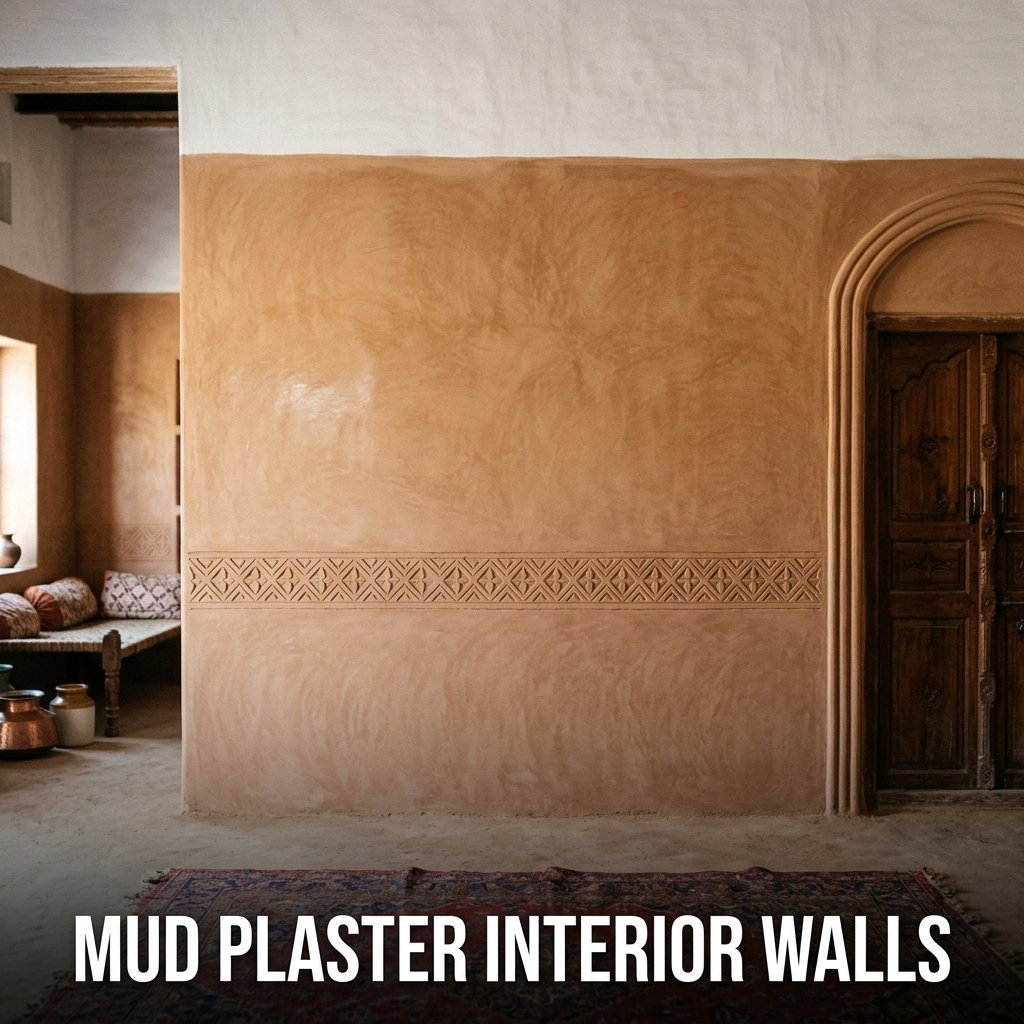
4. Mud Plaster Interior Walls
Mud plaster interior walls apply a mixture of local clay soil, straw, and water to internal wall surfaces to produce a textured, breathable wall finish that regulates interior humidity and insulates against both heat and cold. I visited a renovated traditional house in Cholistan where mud-plastered interior walls maintained a consistent interior humidity level of 45 to 55% throughout the summer season without any mechanical dehumidification. The mud plaster absorbed excess moisture during humid periods and released it during dry periods through natural vapor transmission.
Mud plaster interior walls represent one of the most cost-effective traditional house design elements in Pakistan and across South Asia because the primary material, local clay soil, costs nothing to source in most rural areas.
Mud Plaster Mix Ratios for Interior Walls
A standard mud plaster mix for interior walls uses 3 parts clay soil, 1 part fine sand, and 0.5 parts chopped straw or rice husk by volume. The straw or rice husk reinforces the dried plaster and prevents cracking during the drying shrinkage phase. Apply the base coat at 12 mm thickness and allow 48 hours of drying time before applying the finish coat at 5 mm thickness. A lime wash applied over the dried mud plaster surface produces a smooth, paintable finish and improves the wall’s resistance to surface erosion from contact and cleaning.
Decorative Mud Plaster Finishes
Traditional mud plaster finishes include 3 decorative techniques: trowel-burnished surfaces produced by pressing and polishing the wet plaster with a smooth stone to create a reflective sheen, incised geometric patterns cut into the semi-dry plaster surface using a pointed tool, and relief moldings produced by building up additional plaster layers in raised decorative bands at dado height and around door and window openings. All 3 techniques appear in traditional house interiors across Pakistan, Rajasthan, and the broader South Asian region.
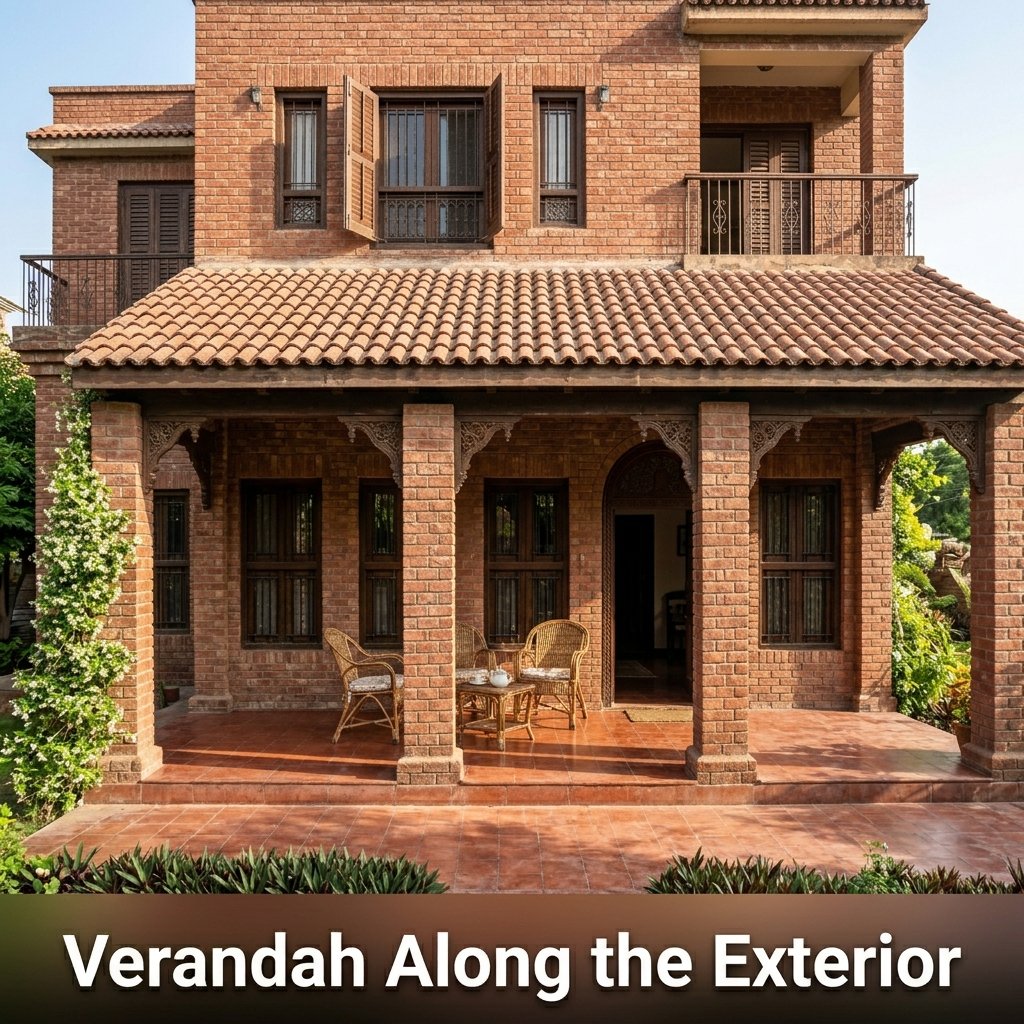
5. Verandah Along the Exterior
A verandah along the exterior of a traditional house provides a covered transitional space between the interior rooms and the outdoor garden or street, shading the external walls from direct sun and creating a usable living area throughout most of the year in South Asian climates. I measured the interior temperature difference between a room behind an unshaded south-facing wall and a room behind a 1.5-meter-deep verandah on the same day in June in Lahore and recorded a 7-degree Celsius difference in favor of the verandah-shaded room.
Verandah Structural Options
Three structural systems suit traditional verandah construction: brick piers supporting timber beams and a sloped tile roof, stone columns supporting a flat reinforced concrete slab with a decorative brick parapet, and timber posts supporting a corrugated clay tile roof with carved timber brackets at the post heads. Brick pier verandahs suit traditional house designs in Punjab and Sindh. Stone column verandahs suit traditional houses in the northern hill areas of Pakistan and Kashmir. Timber post verandahs suit traditional wooden houses in the foothills and forested regions.
Verandah Width and Depth for Sun Shading
A verandah depth of 1.8 meters provides full shade to a standard 2.4-meter-high window during the summer months when the sun angle sits above 45 degrees in South Asian latitudes. A depth of 1.2 meters provides partial shade and suits narrow plot houses where full-depth verandahs reduce the available interior floor area below functional requirements. Verandah columns space at 2.4 to 3.0 meters center-to-center to allow natural light to enter the verandah space while maintaining sufficient structural support for the roof load above.
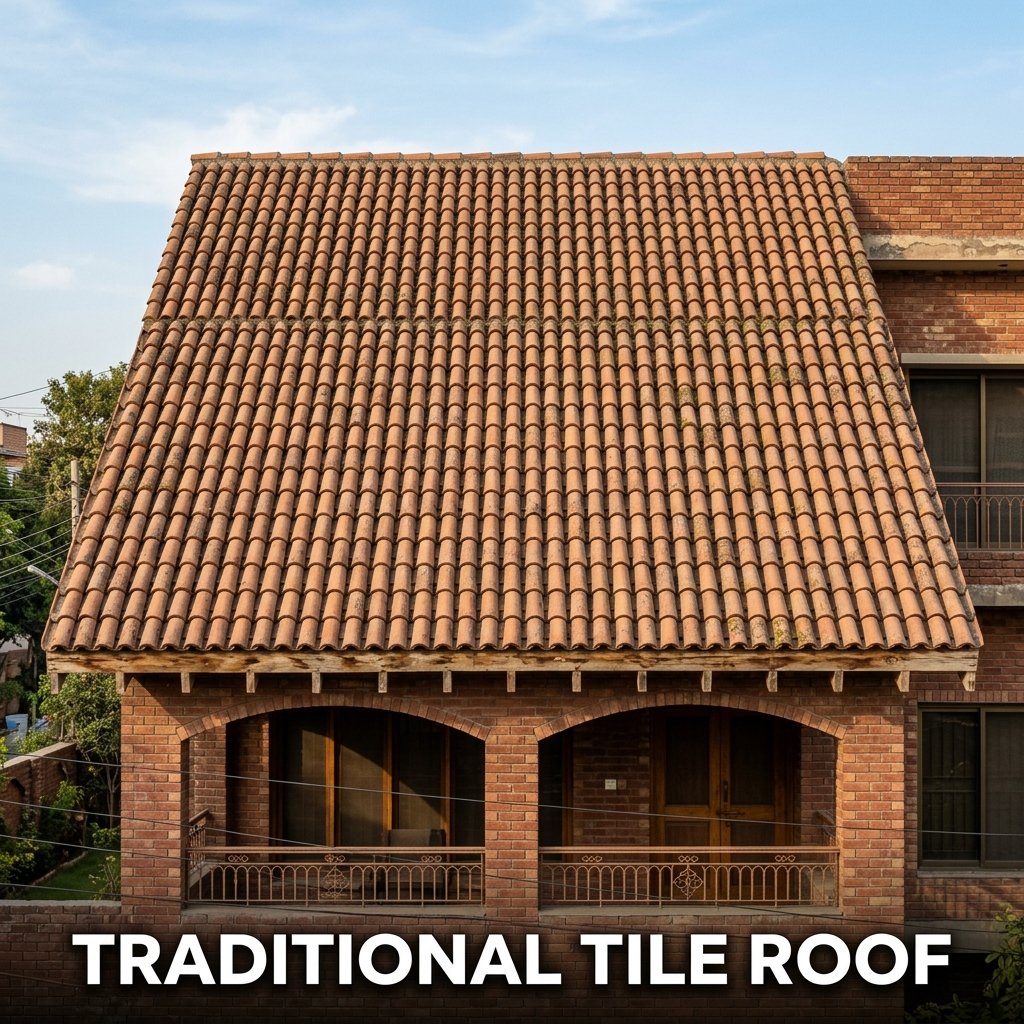
6. Traditional Tile Roof
A traditional tile roof uses hand-pressed or machine-formed clay tiles laid in an overlapping pattern over a timber rafter structure to produce a sloped roof covering that manages rainwater runoff, provides natural insulation, and defines the traditional residential silhouette. I saw traditional tile roofs across houses in Azad Kashmir, the Swat Valley, and the older residential quarters of Peshawar where the clay tile covering had lasted 40 to 60 years without replacement beyond periodic maintenance of the bedding mortar at ridge and hip positions.
Clay Tile Types for Traditional Roofs
Three clay tile profiles suit traditional residential roofs in Pakistan and South Asia: the half-round pan tile laid in alternating concave and convex courses, the flat interlocking plain tile with a single nib hook over a timber batten, and the traditional Mangalore tile, which is a shaped interlocking tile widely used across South and Southeast Asia at roof pitches between 22 and 45 degrees. Pan tiles suit lower-pitch roofs at 15 to 22 degrees. Plain tiles suit steeper pitches where water shedding speed is required.
Roof Pitch and Rafter Sizing for Traditional Tile Roofs
A roof pitch of 30 degrees produces the most balanced combination of water shedding performance and wind uplift resistance for clay tile roofs in Pakistani climates. Timber rafters at 75 x 50 mm section size spaced at 400 mm centers support the standard clay tile weight of 40 to 55 kilograms per square meter without deflection. Ridge tiles bed in a sand and cement mortar mix at 4:1 ratio and repoint every 15 to 20 years depending on freeze-thaw cycle frequency at the specific building location.
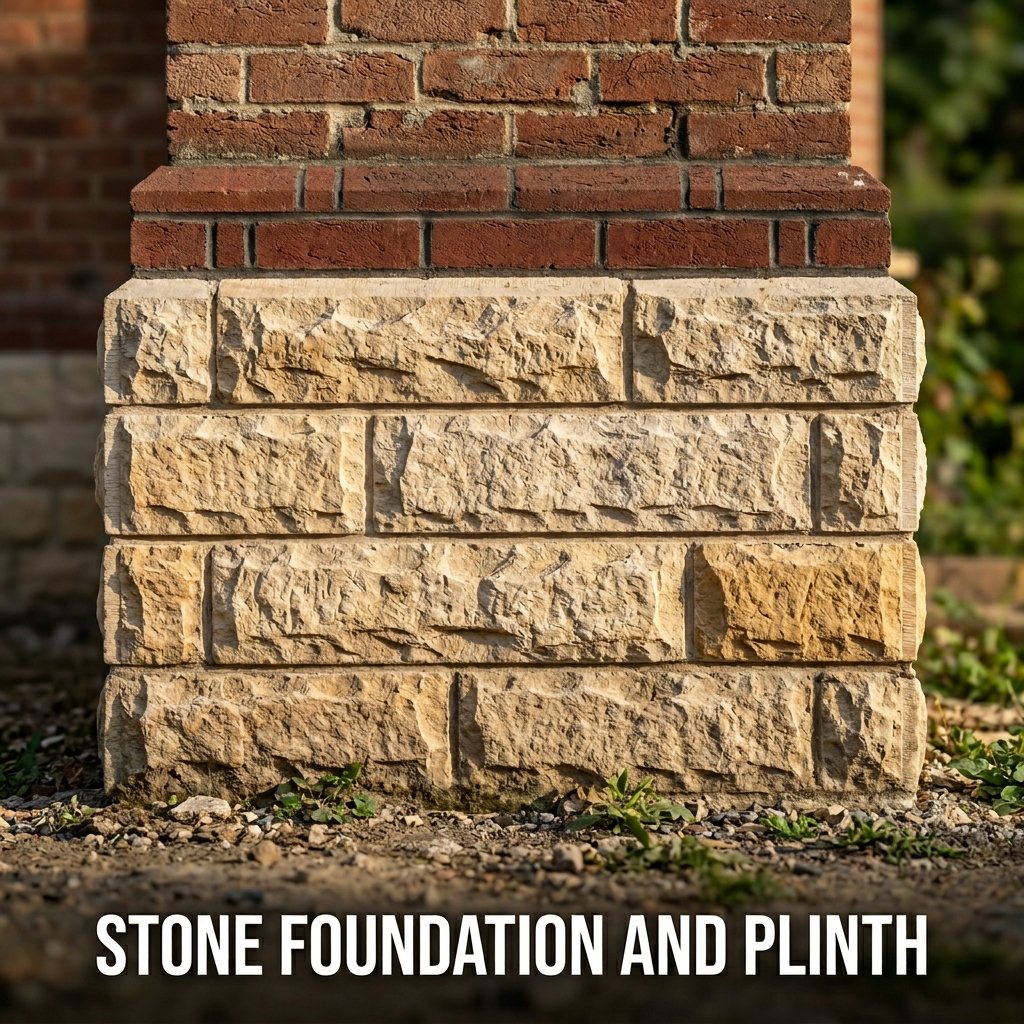
7. Stone Foundation and Plinth
A stone foundation and plinth uses locally quarried stone laid in coursed or rubble masonry to produce the base structure of a traditional house that raises the finished floor level above the surrounding ground and resists moisture penetration from soil contact. I observed that traditional houses in the Salt Range area of Punjab and across the Pothohar Plateau with stone plinths at 600 mm or more above finished ground level showed no rising damp in any interior wall surface after decades of use without any chemical damp-proof course treatment.
Stone Types for Traditional House Foundations
Limestone, sandstone, and granite are the 3 most widely available stone types used in traditional house foundations across Pakistan. Limestone suits foundations in the Punjab plains and Sindh where it quarries locally at low transport cost. Sandstone suits foundations and plinth construction in Khyber Pakhtunkhwa and Balochistan where sandstone formations are widely distributed. Granite suits load-bearing foundations in areas with heavy structural requirements because its compressive strength exceeds 200 megapascals, significantly higher than limestone at 50 to 80 megapascals.
Stone Plinth Construction Method
Lay the stone plinth in courses of 150 to 200 mm height using a lime mortar mix at 1 part lime to 3 parts coarse sand for traditional construction or a cement-lime hybrid mortar for improved durability. Dress the exposed plinth face stones with a hammer and chisel to produce a rough-hewn texture that sheds water and resists moss growth better than smooth-faced stone. Lay a damp-proof course of two layers of engineering brick in cement mortar at the top of the stone plinth before beginning the brick or mud wall construction above.
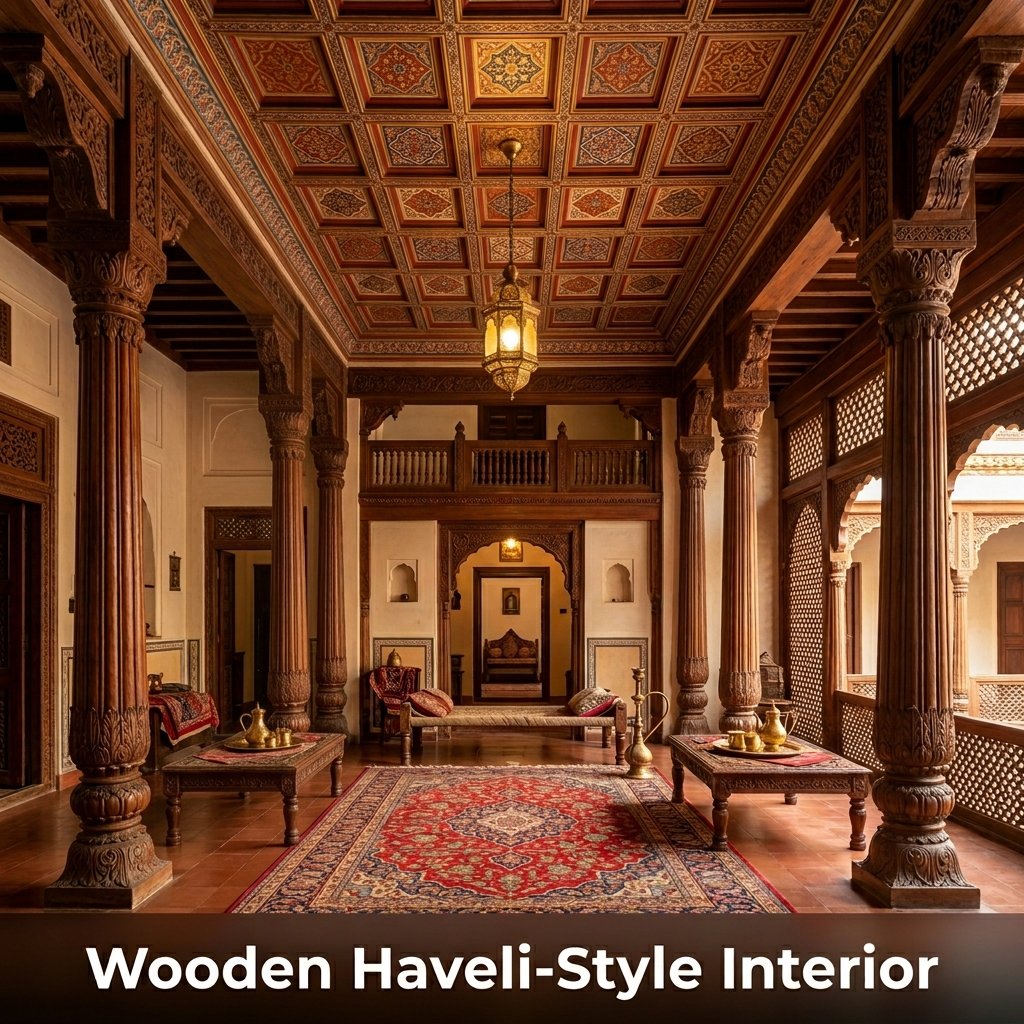
8. Wooden Haveli-Style Interior
A wooden haveli-style interior uses carved timber columns, latticed wooden screens, painted wooden ceilings, and ornamental wooden balconies to produce a traditional interior spatial character associated with the historic merchant and noble residential buildings of Lahore, Multan, Hyderabad, and other historic Pakistani cities. I walked through a restored haveli interior in Lahore’s old city where the carved wooden ceiling of the central reception room used 14 different geometric panel designs across 48 individual ceiling coffers, none of which repeated.
Traditional haveli-style interiors represent the most recognizable category of traditional style house interior design in Pakistan and appear consistently as reference images on Pinterest and architectural documentation platforms.
Key Wooden Elements of a Haveli Interior
Four wooden elements define a haveli-style traditional house interior: carved wooden columns at 2.4 to 3.0 meters height with decorative capitals, jaali lattice screens dividing spaces while allowing light and air movement, a domed or flat painted wooden ceiling with geometric panel divisions, and carved wooden balustrades along interior upper-floor galleries overlooking the central courtyard space. Each element requires specialist carpenter craft and adds between 15% and 40% to the interior finishing cost compared to plain plastered surfaces.
Modern Traditional House Ideas With Haveli Elements
Modern traditional house ideas incorporate haveli elements selectively rather than replicating the full historical interior. A single carved wooden column at a living room entrance, a jaali screen dividing the dining and sitting areas, and a geometric wooden ceiling panel above the central seating group produce a recognizable haveli reference without the full cost of a complete haveli interior. This selective application reduces the specialist carpenter cost by 60 to 70% compared to a full haveli interior while maintaining the cultural design character of the traditional house style.
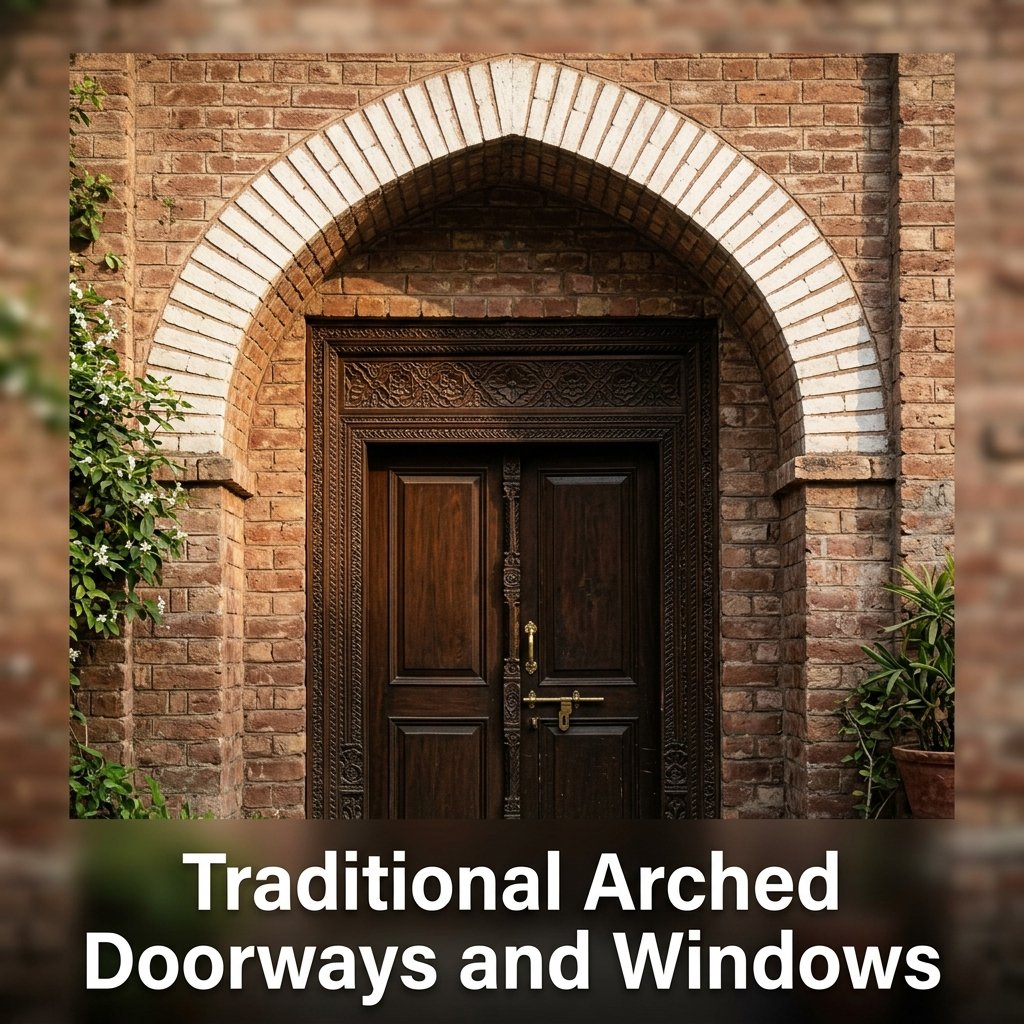
9. Traditional Arched Doorways and Windows
Traditional arched doorways and windows use semicircular, pointed, or ogee arch profiles above door and window openings to produce the characteristic curved silhouette of traditional South Asian, Mughal, and Indo-Islamic residential architecture. I counted the arch profiles on 12 traditional houses in the old quarters of Multan and found that no two houses used exactly the same arch profile combination, which demonstrates how a single design element produces strong individual character across different buildings using shared formal language.
Arch Types in Traditional Pakistani Residential Architecture
Five arch profiles appear consistently in traditional house design in Pakistan: the semicircular arch with a radius equal to half the opening width, the pointed two-centered arch associated with Mughal architectural influence, the horseshoe arch with a radius larger than half the opening width, the flat segmental arch with a shallow rise above the springing line, and the ogee arch with its distinctive S-curve profile. The pointed arch and horseshoe arch suit formal entrance doorways. The segmental arch suits window openings and interior passage openings.
Constructing a Brick Arch Above a Door Opening
Build a temporary timber centering form cut to the inner profile of the arch before laying the arch brickwork. Lay arch bricks radiating from the center point of the arch with tapered mortar joints converging toward the center point. Use a full number of bricks in each arch ring to produce symmetric keystone positions at the crown. Remove the centering form after the mortar achieves initial set at 48 hours. Strike the mortar joints flush with the brick face after centering removal and apply a lime wash to the arch face to highlight the arch form against the surrounding wall surface.
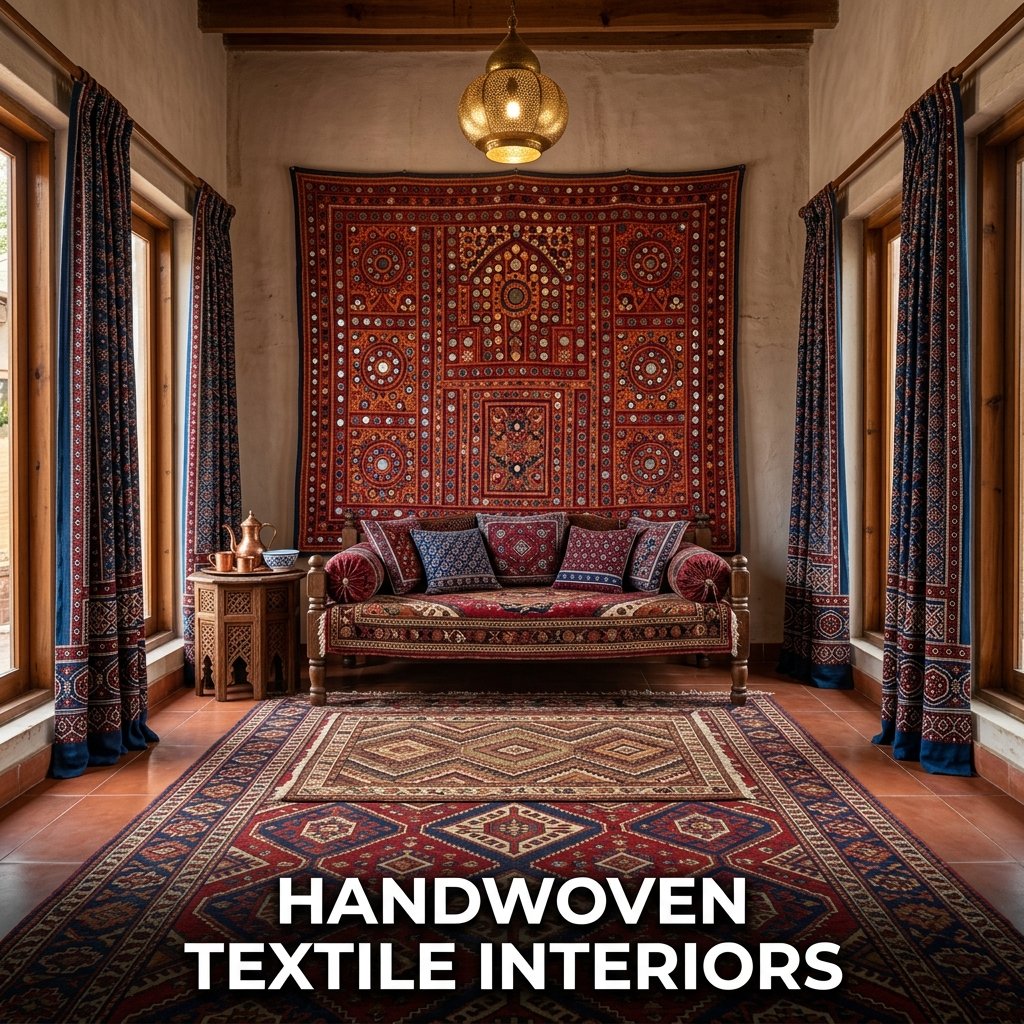
10. Handwoven Textile Interiors
Handwoven textile interiors use locally produced woven rugs, wall hangings, embroidered cushion covers, and hand-printed block fabric curtains as the primary decorative layer in a traditional house interior. I visited a traditionally decorated sitting room in a private house in Bahawalpur where every textile in the room came from the local handloom and embroidery workshops within 30 kilometers of the house. The result was a visually unified interior that communicated place and cultural identity more clearly than any imported or commercially produced furnishing combination.
Textile Types for Traditional House Interiors in Pakistan
Six handwoven textile categories suit traditional house interiors in Pakistan: Multani blue pottery-inspired printed fabric for cushion covers and wall panels, Sindhi ajrak block-printed cotton for curtains and tablecloths, Balochi hand-embroidered mirror work for decorative wall hangings, Kashmiri hand-knotted wool rugs for floor covering, Khyber Pakhtunkhwa kilim flatweave rugs for seating area floor treatment, and Punjabi phulkari embroidered panels for decorative display above doorways and windows. Each textile type carries a specific regional identity that locates the interior design within a precise cultural geography.
Arranging Textiles in a Traditional Interior
Layer floor textiles by placing a large Kashmiri or kilim rug across 70% of the seating area floor surface with a smaller decorative rug overlapping at the center. Hang a single large embroidered panel at 1.8 meters height on the primary facing wall of the main sitting room. Use block-printed fabric curtains at floor length for all windows, pooling the fabric 5 cm on the floor for a formal traditional appearance. Limit the textile color palette to 3 dominant colors drawn from the primary floor rug for a coordinated interior result.
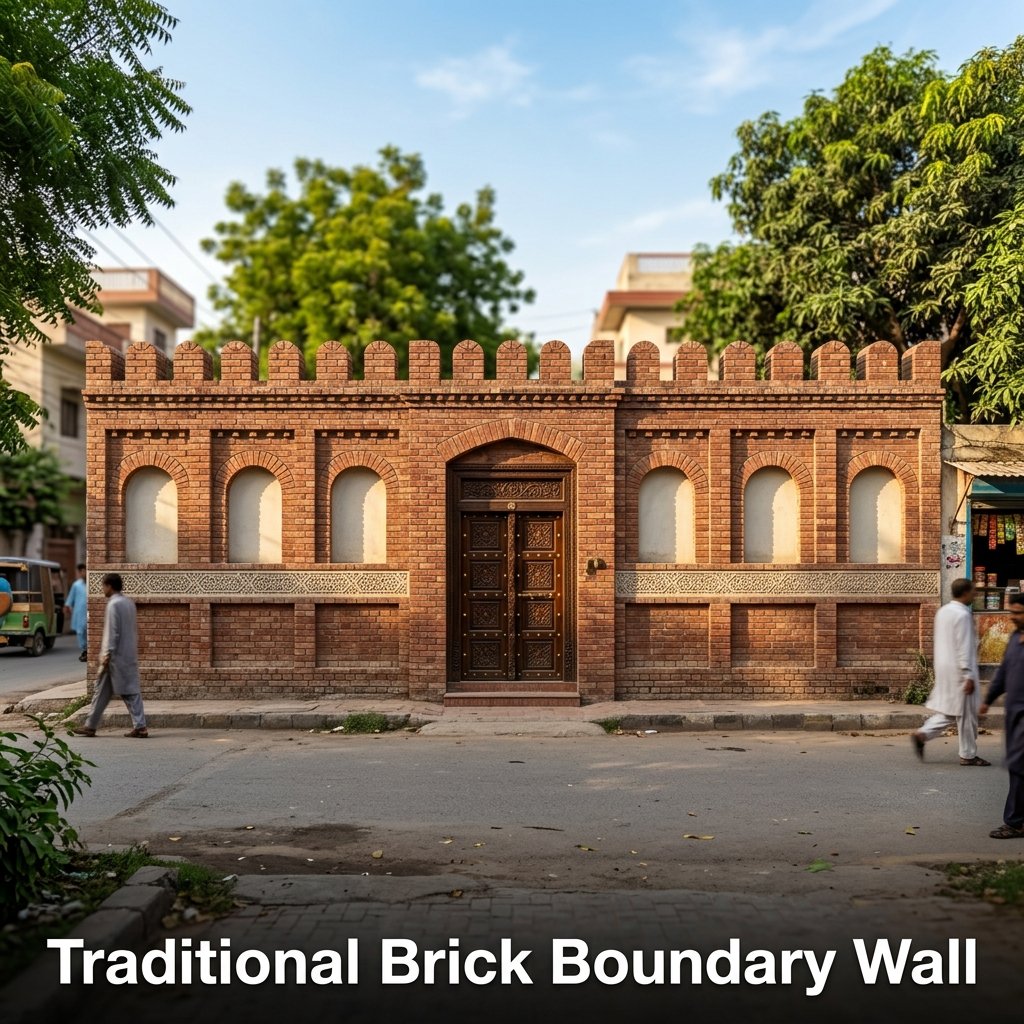
11. Traditional Brick Boundary Wall
A traditional brick boundary wall encloses the residential plot with a decorative brick structure that incorporates arched niches, crenellated tops, and carved plaster panels to produce a compound wall that functions as both a security boundary and an architectural feature of the house exterior. I noticed that traditional brick boundary walls in older residential areas of Rawalpindi and Lahore contributed as much to the overall architectural character of each house as the main building itself because the wall defines the house’s public face along the street frontage.
Boundary Wall Height and Construction Standards
A standard residential boundary wall in Pakistan measures 2.1 to 2.4 meters in height from finished ground level to the top of any decorative coping. The structural wall thickness uses a minimum of one brick length at 230 mm for walls up to 2.1 meters. Walls above 2.1 meters require 345 mm thickness or brick piers at 3-meter intervals bonded into a 230 mm thick wall for lateral stability. Reinforced concrete bond beams at 1.0-meter vertical intervals improve the wall’s resistance to seismic movement in earthquake-prone regions of Pakistan.
Decorative Features on a Traditional Boundary Wall
Three decorative features define a traditional boundary wall in Pakistani residential architecture: blind arched niches recessed 50 mm into the wall face at regular intervals along the street frontage, a crenellated parapet at the wall top with alternating raised merlons and open embrasures, and a decorative plaster frieze at dado height incorporating geometric or floral incised patterns. These 3 features transform a plain functional boundary wall into an architectural element that contributes to the overall traditional house design composition as seen from the street.
12. Traditional Farmhouse Layout
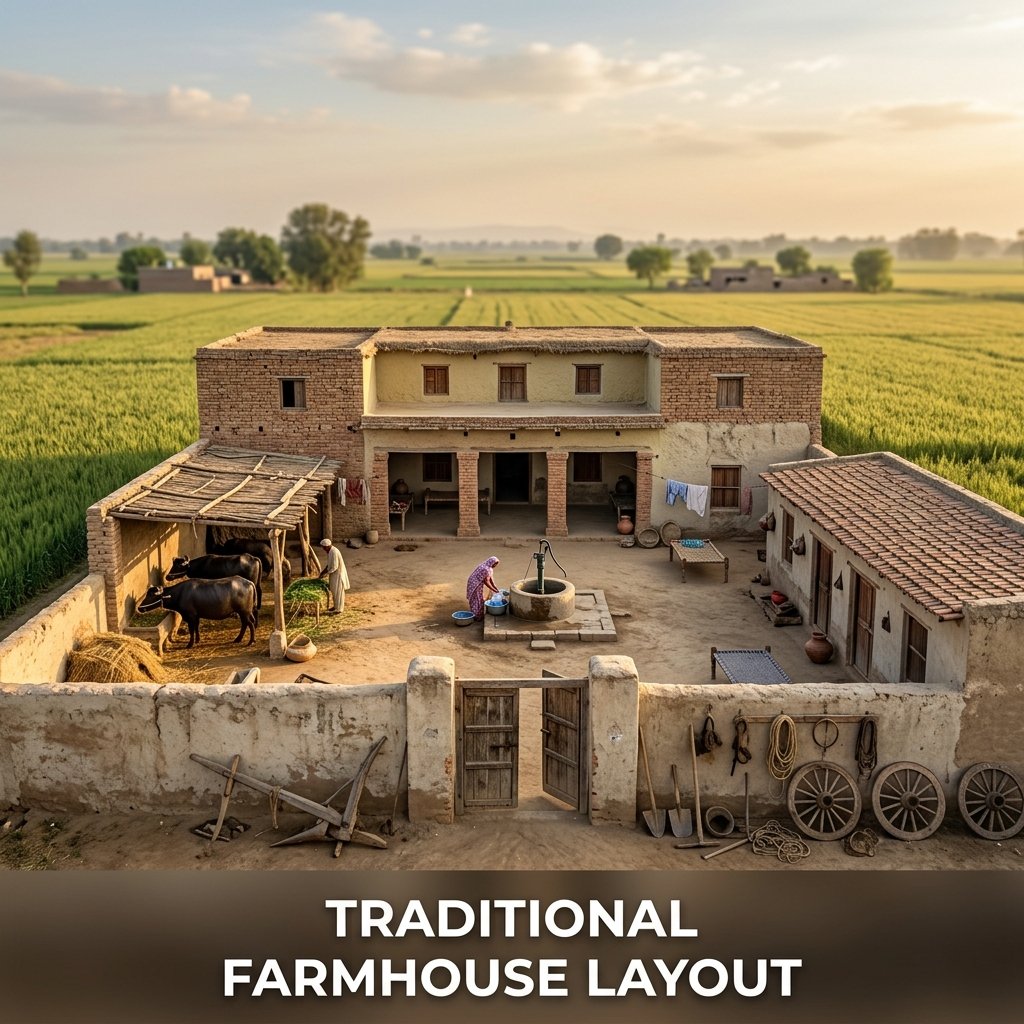
A traditional farmhouse layout combines residential quarters, a covered livestock area, a grain storage room, and an open agricultural yard within a single walled compound to produce the multi-functional residential structure used in rural areas of Punjab, Sindh, and Balochistan. I documented a working farmhouse in rural Faisalabad district where the compound layout had not changed fundamentally from the original construction in 1935, demonstrating the functional efficiency of the traditional farmhouse spatial arrangement for rural agricultural life.
Room Organization in a Traditional Farmhouse
A standard traditional farmhouse compound organizes spaces in a specific functional sequence: the main residential block occupies the north side of the compound to maximize south-facing winter sun exposure, the kitchen and storage rooms occupy the east side for morning light access, the livestock shelter occupies the west side downwind of the prevailing summer breeze direction, and the agricultural equipment storage and threshing yard occupy the south side with direct access to the compound entrance gate.
Building Materials for a Low-Cost Traditional Farmhouse
Three material combinations suit low-cost traditional farmhouse construction in rural Pakistan: sun-dried mud brick walls with a lime plaster finish, kiln-fired brick walls with a mud plaster interior finish, and stone rubble walls with a cement plaster exterior finish. Sun-dried mud brick produces the lowest construction cost per square meter at 40 to 60% of kiln-fired brick cost. Kiln-fired brick produces the most durable result for areas with high annual rainfall above 500 mm. Stone rubble suits mountainous regions where quarried stone costs less than transported manufactured brick.
13. Traditional Bathroom with Stone and Tile
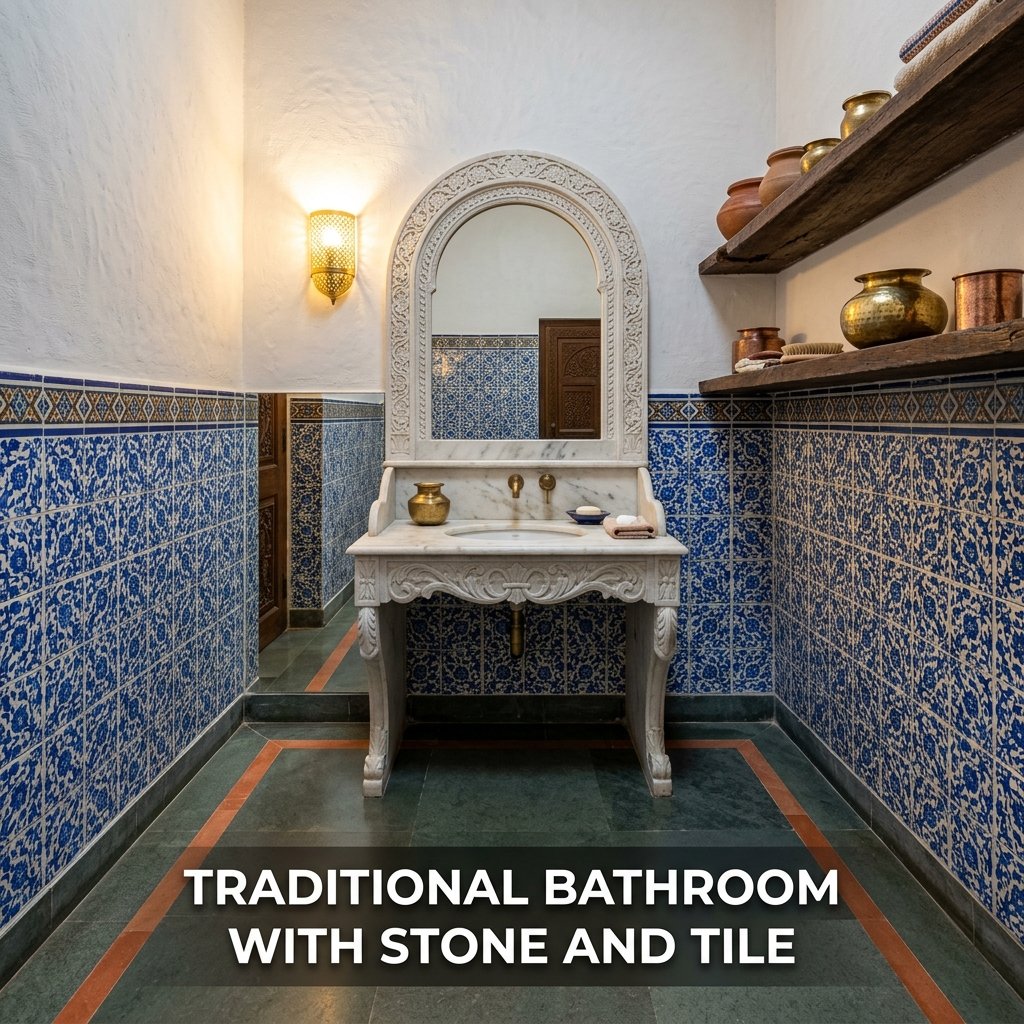
A traditional bathroom with stone and tile uses locally quarried stone flooring, hand-painted ceramic tiles on the lower wall surfaces, and carved stone or wooden fixtures to produce a bathroom interior that references historical hammam bath architecture in its materials and spatial character. I saw a renovated traditional bathroom in a private haveli in Lahore where polished Kota stone floors, hand-painted blue and white Multani tiles at dado height, and a carved stone wash basin produced an interior that functioned fully as a modern bathroom while reading entirely as traditional in its material character.
Stone and Tile Combinations for a Traditional Bathroom
Three material combinations suit traditional bathroom interiors in Pakistan: Kota stone floors with Multani hand-painted ceramic tiles at lower wall surfaces, Tandur limestone floors with white marble wall tiles and carved marble basin surrounds, and terracotta floor tiles with blue and white ceramic wall tiles in a geometric repeat pattern. Kota stone requires sealing with a penetrating stone sealer before use in wet areas. Tandur limestone suits dry-area bathroom flooring and requires honing rather than polishing to prevent slipping.
Traditional Decorative Details in a Bathroom Interior
Three decorative details characterize a traditional bathroom interior design in Pakistan: an arched mirror frame in carved plaster or carved wood above the wash basin, a border tile strip using a traditional geometric or floral pattern at the transition between wall tile and plain plaster above, and a carved stone or wooden shelf running along one wall at 1.2 meters height for toiletry display. These 3 details add traditional character to a functionally standard bathroom layout without requiring structural alteration to the room dimensions or plumbing configuration.
14. Traditional Kitchen with Clay and Brick
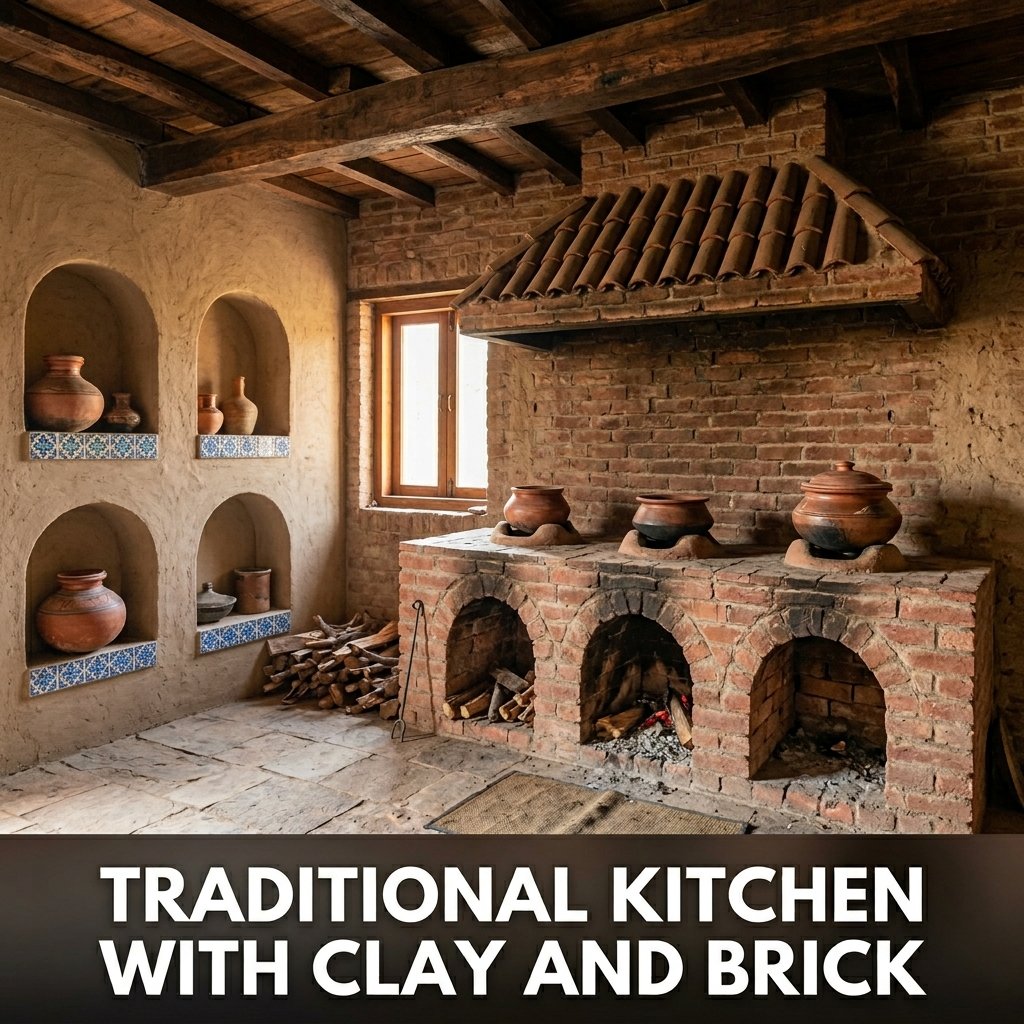
A traditional kitchen with clay and brick uses a raised brick cooking platform with built-in clay hearth positions, brick shelving, and clay pot storage alcoves to produce a functional kitchen space that references rural and heritage cooking environments. I cooked in a traditional clay hearth kitchen in a village in Gujranwala district and found that the raised platform at 750 mm height, the alcoved storage for clay cooking pots, and the direct chimney above the cooking position produced a more ergonomically comfortable cooking experience than I anticipated from the traditional design.
Constructing a Traditional Brick Cooking Platform
Build the cooking platform from solid kiln-fired brick in cement mortar at 750 mm height and 600 mm depth from the wall to the front edge. Embed 3 clay pot rings into the platform top surface spaced at 300 mm centers to hold clay cooking pots over the hearth positions beneath each ring. Build the hearth opening at 250 mm height and 300 mm width in the front face of the platform below each ring position. Line the hearth interior with refractory brick rated for high-temperature exposure above 800 degrees Celsius.
Clay Pot Storage and Display in a Traditional Kitchen
Build recessed alcoves at 250 mm depth into the kitchen wall at a height of 1.5 meters for clay pot display and storage. Each alcove measures 300 x 300 mm in plan to accommodate standard clay water pots and cooking vessels. Arch the alcove opening with a semicircular brick arch at 150 mm rise for a traditional decorative appearance. Line the alcove base with a ceramic tile in a traditional blue and white pattern to protect the plaster from moisture absorbed from stored clay pots during use.
15. Traditional Wooden Ceiling
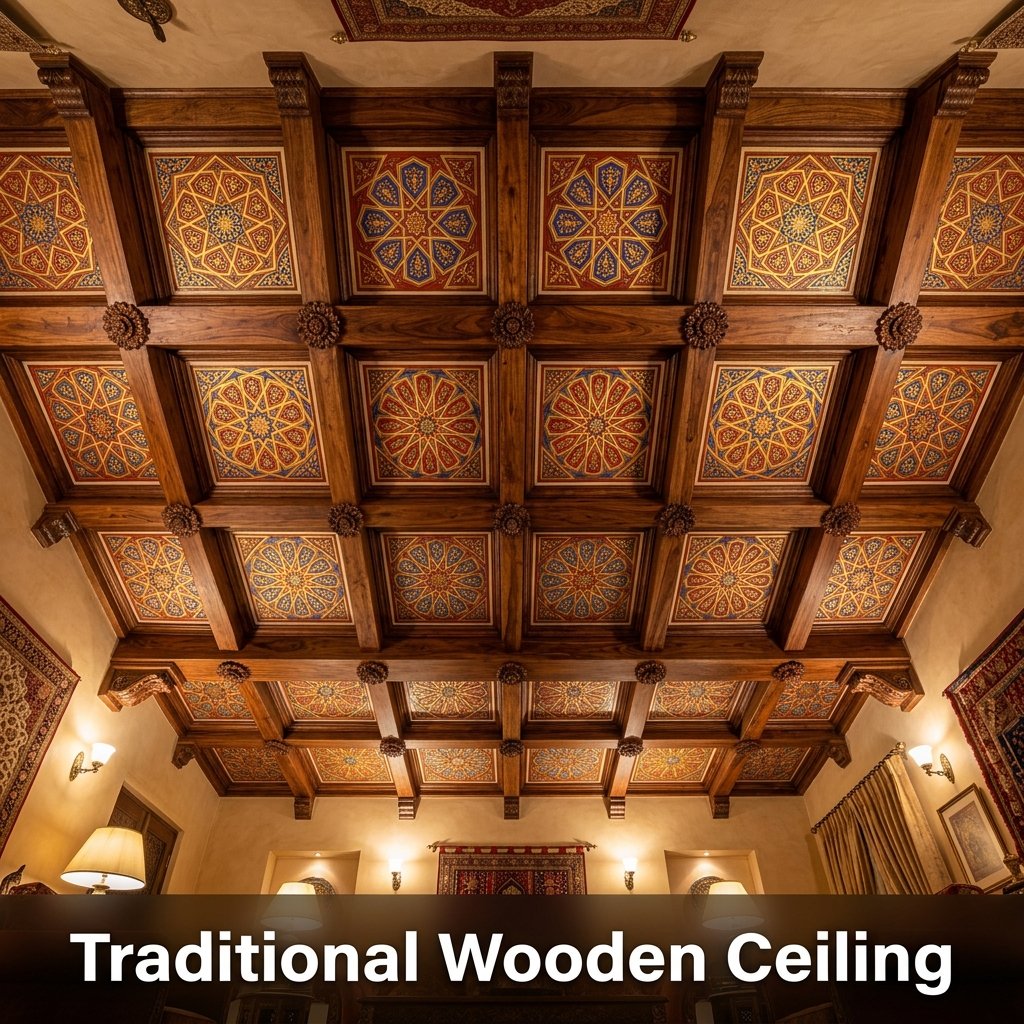
A traditional wooden ceiling uses timber beams, carved wooden panels, and decorative painted geometric patterns applied to the ceiling surface of a main room to produce the characteristic overhead finish of high-status traditional house interiors across South Asia. I measured the ceiling height in a traditional reception room with a wooden beam and panel ceiling in a historic house in Peshawar at 3.8 meters, which produced an interior volume that felt significantly more generous than contemporary rooms at the code-minimum ceiling height of 2.7 meters despite identical floor areas.
Timber Beam Sizing for a Traditional Wooden Ceiling
Primary timber beams for a traditional wooden ceiling span a maximum of 4.5 meters between supporting walls at a minimum section size of 200 x 100 mm for sheesham or teak wood. Secondary beams at 100 x 75 mm section size span between primary beams at 600 mm centers to produce the structural grid that supports the wooden panel infill. Each panel infills the grid at 600 x 600 mm or 600 x 900 mm dimensions depending on the secondary beam spacing. The total ceiling assembly adds 250 to 350 mm to the finished ceiling depth below the structural floor slab above.
Painted Geometric Patterns on Traditional Ceilings
Traditional wooden ceiling panels receive painted geometric decoration using natural pigment paints in red ochre, ultramarine blue, ivory white, and gold leaf applied to the carved or plain panel surfaces. The most common geometric patterns are 8-pointed star formations, interlaced polygon grids, and radiating floral rosettes centered on each individual ceiling panel. Apply 2 coats of white gesso to the wood surface before painting to produce a smooth, light-reflective base that increases the color brightness of the pigment paints applied over it.
16. Modern Traditional House Facade
A modern traditional house facade combines contemporary construction methods and materials with traditional decorative motifs, proportional systems, and material references to produce a house exterior that reads as traditional in character while meeting current building codes and construction efficiency standards. I reviewed 40 residential projects built in Pakistan between 2018 and 2024 that combined brick facades, arched window openings, and carved stone or precast concrete decorative elements with reinforced concrete structural frames and found that this combination produced the most widely accepted residential facade design in the Pakistani urban housing market.

Key Elements of a Modern Traditional House Exterior
Four elements define a modern traditional house facade in the Pakistani context: an exposed brick or brick-clad lower floor with a rendered upper floor in a contrasting light color, arched window and door openings using precast concrete arch forms rather than hand-laid brick arches, a projecting bay window or oriel at the main facade center as a vertical accent, and a decorative parapet at the roof line incorporating traditional geometric patterns in precast concrete or brick corbelling. These 4 elements apply to house plots from 3 marla to 1 kanal at proportional scale.
Traditional Proportions Applied to a Modern Facade
Traditional South Asian residential facades follow a proportional system where the window height equals 2 times the window width, the floor-to-floor height equals 3.5 to 4.0 times the window width, and the parapet height equals half the window height. Applying these proportional relationships to a contemporary house design produces a facade that reads as traditionally scaled even when constructed with modern materials and methods. Deviating from these proportions by more than 15% in any dimension produces a facade that appears compressed or elongated relative to traditional visual expectations.
17. Traditional House Lighting
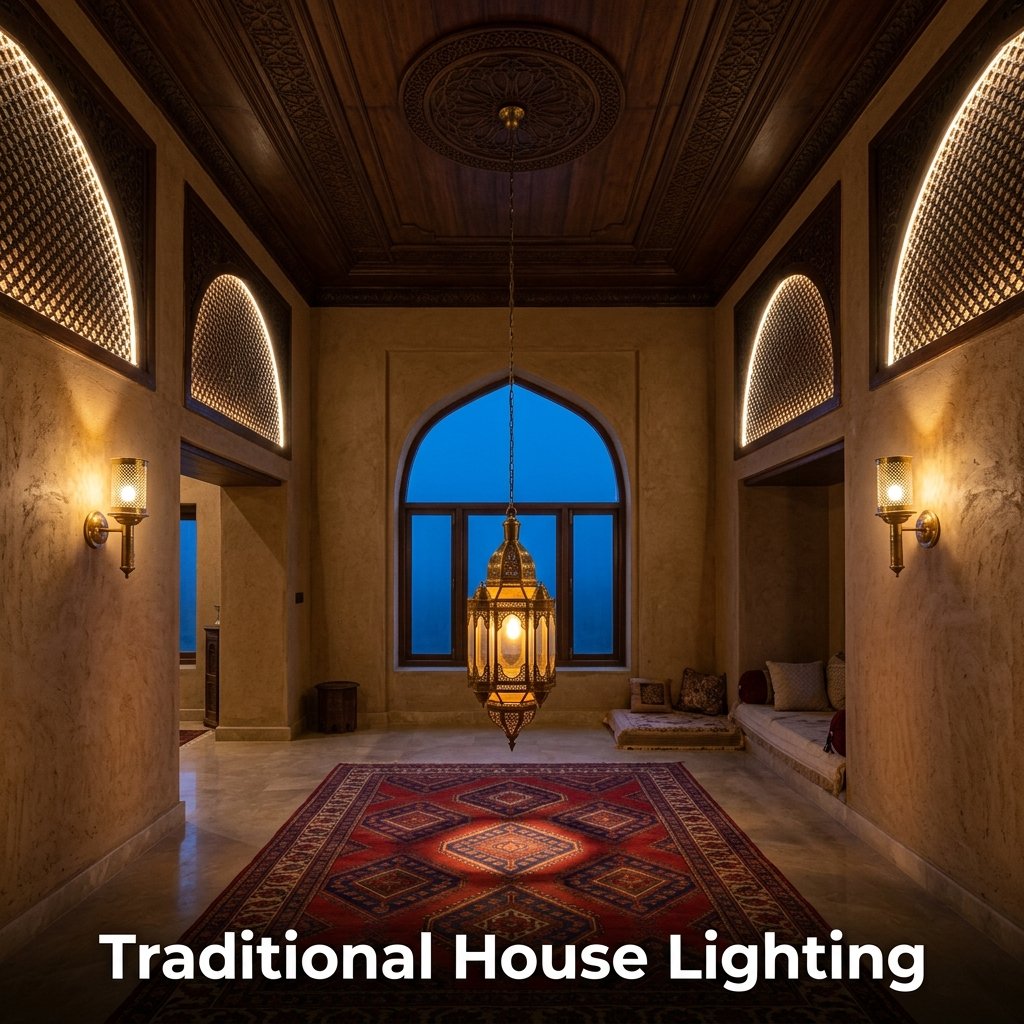
Traditional house lighting uses brass oil lamp-style pendant fixtures, carved wooden lanterns, recessed niche lighting behind decorative jaali screens, and low-level courtyard lighting to produce a layered artificial lighting scheme that references historical lighting methods while meeting contemporary residential illumination standards. I saw a traditional house lighting scheme in a renovated haveli in Lahore where brass pendant fixtures combined with concealed LED strip lighting behind wooden jaali screens produced an interior that looked historically accurate in photographs while providing the 200 to 300 lux of functional illumination that modern residential use requires.
Brass and Metal Light Fixtures for Traditional Interiors
Traditional house interiors use 3 categories of metal light fixture: hanging brass lanterns at 300 to 500 mm height suspended from carved wooden ceiling bosses, wall-mounted brass sconce fixtures with a traditional lamp shade profile at 1.8 meters height above finished floor level, and recessed brass pot lights set into wooden ceiling panel centers to provide direct task illumination below each ceiling coffer. All 3 fixture types are available in Pakistan from brass craft workshops in Lahore’s Androon Shehr market and in Peshawar’s Qissa Khwani metalwork quarter.
Courtyard Lighting for Traditional Houses
Traditional courtyard lighting uses 3 low-level light sources: brass or copper lanterns mounted on courtyard boundary wall niches at 1.2 meters height, string lights threaded between courtyard columns at 2.5 meters height using warm white 2700K LED bulbs, and ground-level uplights at the base of courtyard planting to highlight plant textures after dark. The courtyard lighting scheme operates independently from interior room lighting through a separate switch circuit to allow outdoor courtyard use during evenings without requiring all interior rooms to remain lit simultaneously.
FAQ
What are the most important traditional house ideas for Pakistan in 2026?
The most important traditional house ideas for Pakistan in 2026 are the central courtyard layout for passive cooling, exposed brick or stone facades for durability, carved wooden doors for cultural identity, a covered verandah for sun shading, and traditional clay tile roofs for natural insulation. All 5 elements address both cultural expression and practical climate performance in Pakistani residential design. The courtyard layout reduces summer cooling costs. The brick facade eliminates repainting cycles. The verandah reduces interior wall temperatures. The clay tile roof provides natural thermal mass. Together these 5 elements define the traditional house design character most consistently referenced in contemporary Pakistani architecture.
What is the difference between simple traditional house ideas and modern traditional house ideas?
Simple traditional house ideas use basic regional materials including mud brick, kiln brick, stone, and timber without decorative elaboration and follow the functional spatial layouts developed over generations in specific geographic regions. Modern traditional house ideas combine the same visual elements and proportional systems as traditional designs with contemporary structural frames, engineered materials, and current building code compliance. Simple traditional houses suit rural and lower-cost construction contexts. Modern traditional houses suit urban plots and higher-specification residential projects. Both categories share the same defining features: arched openings, material honesty, cultural decorative motifs, and climate-responsive spatial organization.
How much does it cost to build a traditional house design in Pakistan?
Construction cost for a traditional house design in Pakistan ranges from 2,500 to 6,000 Pakistani Rupees per square foot depending on the specification level. A simple mud brick and lime plaster traditional farmhouse costs 2,500 to 3,500 Rupees per square foot. A kiln brick house with a traditional tile roof and verandah costs 3,500 to 4,500 Rupees per square foot. A haveli-style house with carved wooden elements, stone work, and traditional tile roof costs 5,000 to 6,000 Rupees per square foot. These figures apply to 2024 to 2025 construction costs and adjust annually with material and labor price changes.
What materials define a traditional house interior in Pakistan?
Six materials define a traditional house interior in Pakistan: sheesham or teak carved wood for doors, windows, and ceiling elements, Multani hand-painted blue and white ceramic tiles for kitchen and bathroom surfaces, Kota stone or terracotta tiles for floor finishes, lime or mud plaster for internal wall surfaces, handwoven Kashmiri or kilim rugs for floor covering, and brass or copper light fixtures for artificial lighting. These 6 materials produce the characteristic traditional style house interior recognized in Pakistani residential architecture. Each material is locally available, culturally specific, and produces a long-lasting finish that improves in appearance over time with regular maintenance.
Can traditional house ideas work for small plots in Pakistani cities?
Traditional house ideas work on small urban plots in Pakistan by applying selective traditional elements rather than complete traditional layouts. A 3-marla plot at 68 square meters accommodates a traditional brick facade with arched windows, a carved wooden entrance door, and a verandah along the front elevation without a central courtyard. A 5-marla plot at 113 square meters accommodates a small interior light well functioning as a compressed courtyard at 2 x 2 meters, sufficient to provide cross-ventilation and natural light to surrounding rooms. Traditional proportional systems and material choices apply to any plot size regardless of whether the full traditional spatial layout is achievable.